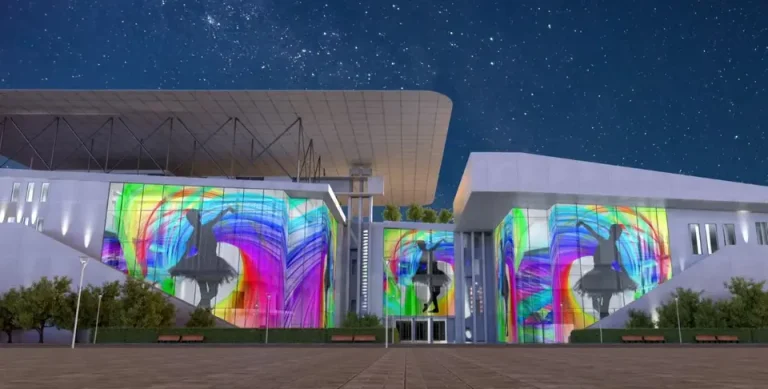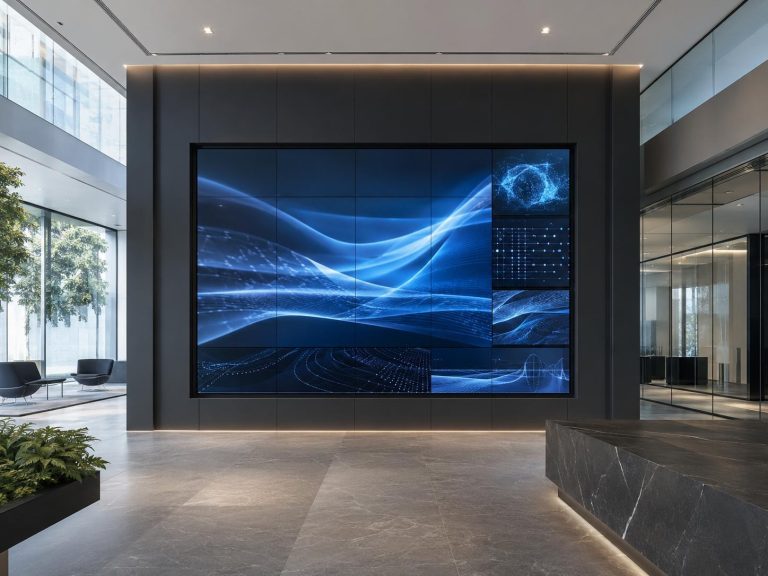
A bar is not a room with a screen in it. It is a room that has to change character four times a night—quiet at eight, full at eleven, relentless at one. That demand is what makes a flat, black, bevel-edged panel feel wrong. It reads as equipment. A flexible LED screen reads as part of the room, because it can follow the column, the curve and the ceiling instead of interrupting them. The question is not whether it looks better, but whether it survives a bar’s operating reality: heat, noise, drinks, twelve-hour shifts and a clientele that photographs everything.
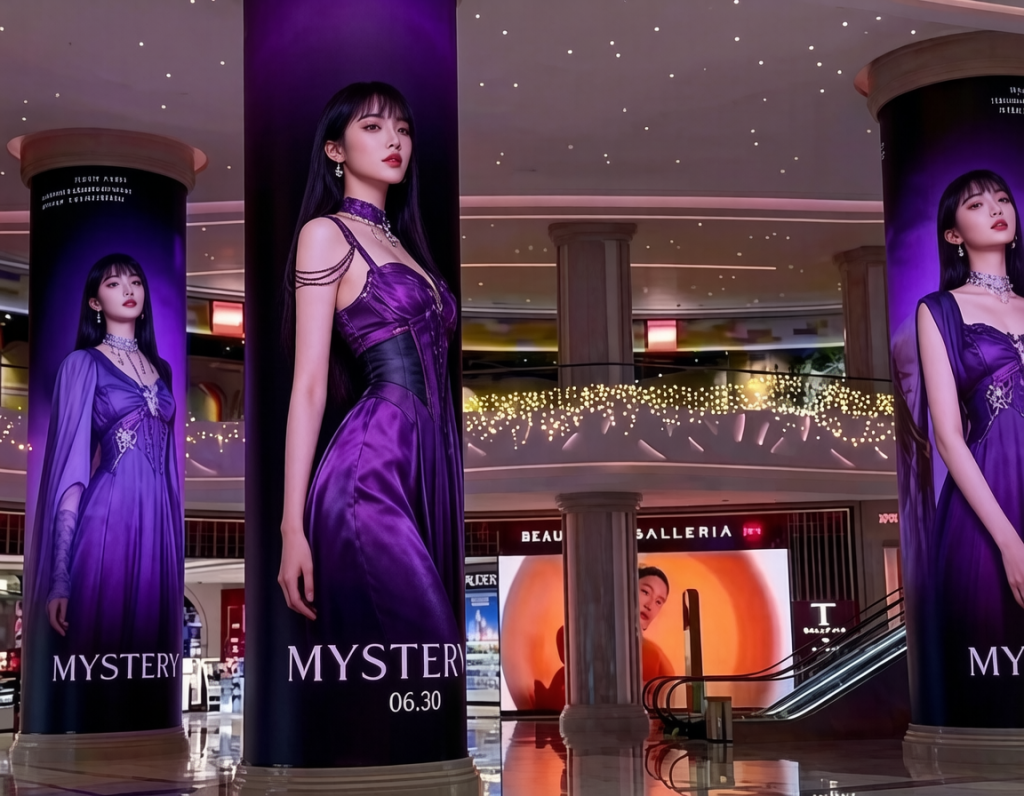
The short answer
- Yes—for curved and irregular architecture. A flexible module bends to columns, arches and cove ceilings where a rigid panel needs a sub-frame and still leaves a visible box.
- The win is seamlessness, not size. Content should read as one continuous surface; visible bezels destroy the effect faster than low resolution.
- Specify for the camera. 3,840 Hz refresh and 14-bit grey scale, or every guest’s phone video will show scan lines.
- Cooling and noise matter more than nits. Bars need fanless or low-noise cabinets at 800–1,500 nits, not a 6,000-nit outdoor panel screaming in a corner.
- Plan the control system with the screen. Dayparted presets, beat-synced cues and one-touch theme switching are what keep the investment useful after the opening party.
1. Why rigid panels struggle in a bar
Three problems show up in almost every nightlife fit-out that uses conventional LED.
Geometry. Bars are full of curves: round columns, arched niches, back-bar sweeps, coffered ceilings. A rigid cabinet is flat by construction. The usual workaround—build a flat wall in front of the curve—costs floor space and produces exactly the boxy look the designer was avoiding.
Visible edges. A large flat panel with a 10 mm bezel, mounted 150 mm off the wall, reads as a television. The eye finds the frame before it finds the image, and the illusion that the room itself is glowing never happens.
Weight and structure. Conventional cabinets run 25–35 kg/m² and need steel. On a mezzanine soffit or an existing decorative wall, that is often a structural survey and a delay. Flexible modules are typically 6–12 kg/m² and can be fixed with magnetic or clip systems directly onto a curved substrate.
2. Shapes, columns and 3D surfaces
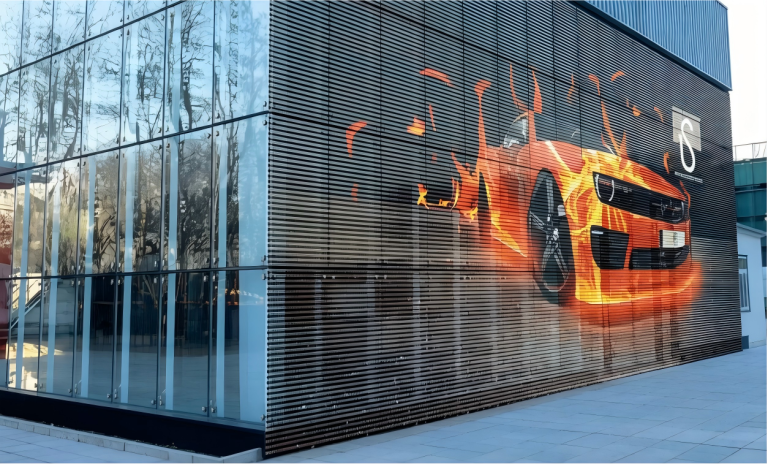
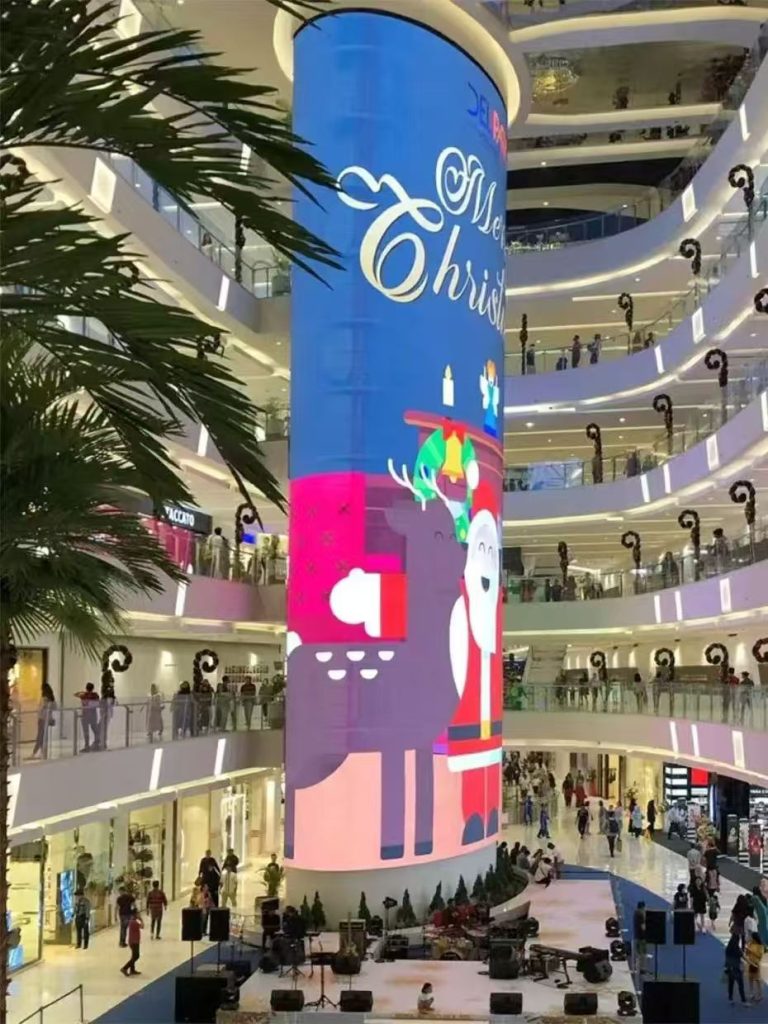
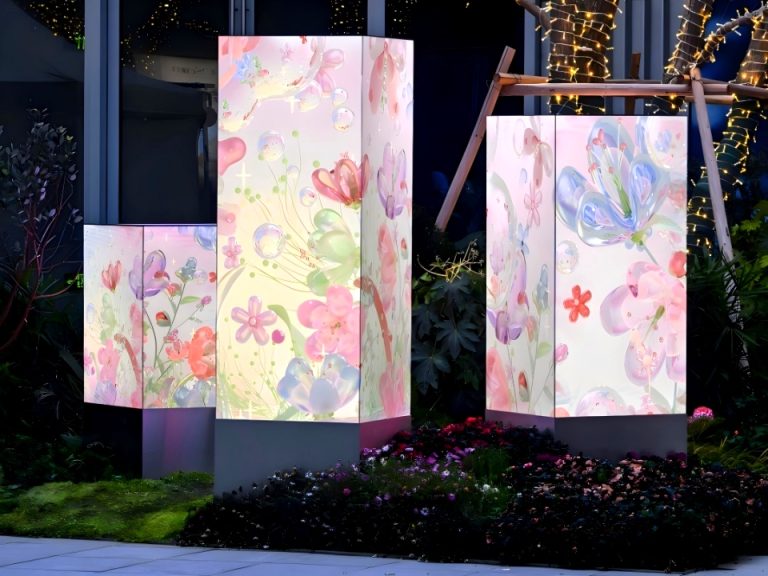
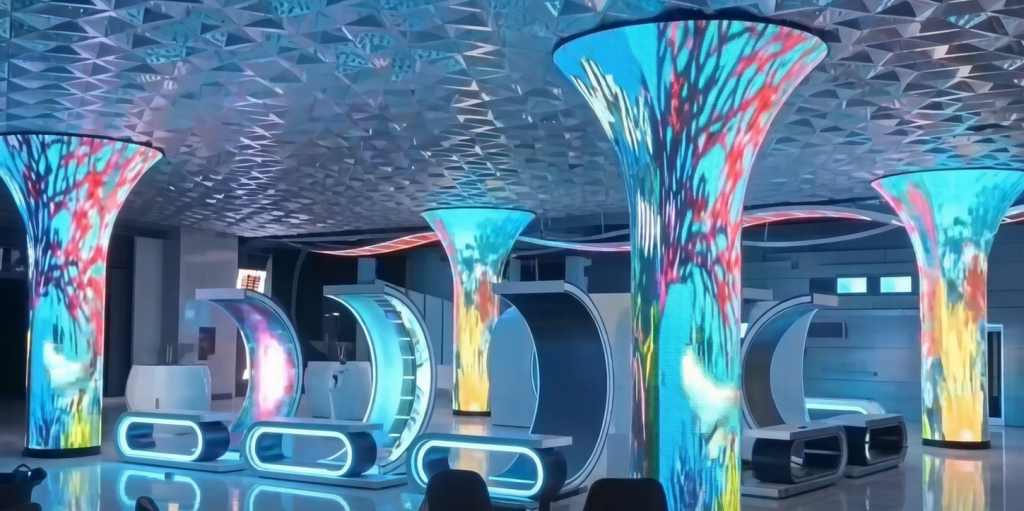
The defining advantage of a flexible LED screen is that curvature becomes a design decision rather than a constraint. Modules bend along one axis—typically to a radius of 200–500 mm depending on the product, with film-based versions going tighter—so a column can be wrapped, a barrel-vault ceiling can be lined, and a wavy back-bar can carry a continuous image.
What that buys, commercially, is a room with no dead zone. A wrapped column can pulse with the music. A curved backdrop can carry a single visual that flows from the entrance to the bar. And because the surface is unusual, it becomes the photograph people take—which is worth more to a venue than any advertisement it could buy.
Best for: venues with structural columns, arched or vaulted ceilings, and any space where the architect already committed to curved forms.
3. Seamless installation: the real product is the absence of a screen
The goal is not a big screen. The goal is a wall that happens to move.
Flexible modules achieve this in two ways. Mechanically, they follow the substrate, so there is no gap between screen and wall to catch light and reveal the trick. Visually, adjacent cabinets are aligned to a fraction of a pixel and driven as one canvas, so a gradient can run across six metres without a step.
Two details decide whether that works in practice. First, the module-to-module tolerance: ask for the flatness and seam specification in millimetres, not “seamless” as a marketing word. Second, the content: a single 16:9 video stretched across a curved wall will always look like a video. Purpose-built content—generative gradients, slow-moving light fields, camera moves designed for the surface—is what makes the screen disappear.
Best for: back bars, DJ booths, VIP alcoves, corridor transitions where a visible frame would break the mood.
4. Content that keeps pace with the night
A bar changes tempo. The screen has to change with it, and that is a specification question before it is a creative one.
| Time of night | Content mode | What the screen must do |
| Early evening, low covers | Slow gradients, warm ambient light, brand visuals | Dim to 20–30% brightness, no visible flicker at low grey levels |
| Peak service | Motion graphics, logo loops, drink features | Stable colour at high saturation; no banding on gradients |
| DJ set | Beat-synced visuals, strobes, high-contrast line work | 3,840 Hz+ refresh, low latency input, cue triggering from the mixer or lighting desk |
| Late night | Deep blacks, minimal motion | True black level; brightness floor low enough not to wash out the room |
Most bar screens are specified for the DJ set and then judged on the quiet hours. Both matter.
Refresh rate is not a detail. At 1,920 Hz, a phone camera will pick up rolling bands across the screen. At 3,840 Hz and above, with 14-bit processing, footage looks clean on Instagram and in the venue’s own content. In a business where guests film constantly, that is free marketing—or free damage.
Sync is what makes it feel alive. The screen should accept timecode or audio-reactive triggers from the lighting console, so a drop in the music is a change in the room, not a change on a separate device that happens to be nearby. Content presets per night—house, hip-hop, theme party—let a bar manager switch the whole look in one tap without calling the integrator.
5. Heat, noise and the realities of a 12-hour shift
A bar screen runs from opening to close, often seven days a week, in a room already full of heat sources: people, lights, sound systems, kitchen pass. Two things follow.
Cooling must be quiet. This is the most overlooked requirement in nightlife projects. A cabinet with high-speed fans mounted above a VIP banquette is a complaint waiting to happen, and near a DJ booth it can be audible in the recording. Specify fanless cabinets for low-brightness indoor use, or temperature-controlled fans that stay below 30 dB in normal operation, and put the power supplies remotely in a plant room where the noise does not matter.
Power and heat are the same bill. Indoor modules typically draw 250–450 W/m² at full white. Running a 20 m² wall at 100% all night is both a heat load and a cost; dropping to 40% brightness after midnight, when the room is darker anyway, cuts consumption roughly in half and extends the life of the emitters.
Then there is the guest problem. Drinks get spilled, glasses get knocked, cleaning crews spray. Indoor LED is not usually rated for wet environments, but the front face should still be sealed and cleanable, with a mask that tolerates a damp cloth and modules that can be replaced individually when someone does the inevitable.
6. Upgradability: the difference between a fit-out and a platform
Bar identities rotate faster than any other hospitality format. Cyberpunk one quarter, disco the next, Halloween, Christmas, a brand takeover in between. If each change means a new screen, the venue stops changing.
The flexible screen earns its place when it is treated as a platform: fixed physical form, variable content. Practical requirements are unglamorous but decisive—a media player that stores multiple playlists, remote content updates so the operator does not need to be on site, and a mounting system that allows a section to be added or moved without rebuilding the wall.
That is also how the investment pays back. The screen is bought once; the room is refreshed four times a year at the cost of content production, not construction.
7. Flexible LED compared with the alternatives
| Option | Best at | Limits in a bar |
| Flexible LED modules | Curved walls, columns, ceilings; high brightness in ambient light | Higher cost per m² than projection; needs proper content design |
| Rigid LED panels | Flat feature walls, stage backdrops, best price per m² | Cannot follow curves; visible framing; heavier structure |
| Projection mapping | Large surfaces, low cost per m², easy to change | Washed out by ambient light; shadows; needs dark surfaces and alignment |
| LED neon / flex strip | Line work, outlines, signage, low budget | No video; decorative only |
| LCD video wall | Sharp close-up imagery in bright rooms | Heavy bezels, seams, poor black level; reads as a TV wall |
Choice follows the surface: if it curves, flexible LED wins by default; if it is flat and dark, projection is often cheaper.
8. Specification checklist for a bar installation
| Parameter | What to specify |
| Pixel pitch | P2.5–P4 for walls viewed within 3 m; P4–P6 for ceilings and back bars seen from 5 m+ |
| Brightness | 800–1,500 nits indoor; auto or scheduled dimming to 20% late night |
| Refresh rate | 3,840 Hz minimum, 14-bit grey scale, for camera-safe output |
| Bend radius | State the tightest radius on the drawings, and require the module to meet it without shadow lines |
| Weight and fixing | kg/m², magnetic or clip system, substrate flatness tolerance |
| Noise | Fanless where possible; otherwise fan noise figure in dB at 1 m |
| Service | Front-service modules; spare modules stored on site |
| Control | Playlists by daypart, DMX or Art-Net trigger, remote updates, scheduled on/off |
| Safety | Flame-retardant mask and cables, earthed metal frame, cable management away from guest reach |
| Warranty | 3–5 years with defined response time for module replacement |
Frequently asked questions
What is the minimum bend radius of a flexible LED screen?
It depends on the product family. Magnetic flexible modules commonly bend to around 300–500 mm radius, tighter-radius versions reach 200 mm, and adhesive LED film can follow considerably tighter curves. Always quote the radius from your drawings and ask the supplier to confirm it in writing—”flexible” without a number is not a specification.
How bright should a bar LED screen be?
800–1,500 nits is usually right for an indoor venue with controlled lighting. Higher figures waste power and generate heat, and a 5,000-nit panel at close range is uncomfortable for guests. What matters more is the ability to dim smoothly to 20% or lower without flicker or colour shift.
Will the screen be noisy near the DJ booth?
Only if it is air-cooled with high-speed fans. For low-brightness indoor installations, fanless cabinets are available and are the correct choice above seating and near audio equipment. If fans are unavoidable, put power supplies in a remote plant room and specify the noise figure in dB at one metre.
Can a flexible screen be installed on an existing curved wall?
In most cases yes, provided the substrate is sound and its curvature is consistent. The screen is mounted on a light sub-frame or magnetic rail that follows the wall, so the wall does not need to be rebuilt. What must be checked first is the flatness of the substrate and the load capacity of the structure behind it.
Is flexible LED worth it if my walls are all flat?
Usually not. On a flat wall, a rigid panel delivers the same image for less money. The premium for flexibility is justified by curvature, by weight limits, or by the need to wrap columns and ceilings—not by the word “flexible” on a brochure.
Final thoughts
Flexible LED screens suit bars for a reason that has little to do with technology: they let the architecture stay in charge. The column remains a column, the curve remains a curve, and the light moves through them instead of being pasted on top. That is what guests describe as atmosphere and what they photograph without being asked.
But the format is only half the decision. A bar screen lives or dies on the boring specifications—refresh rate for the cameras, noise for the seating, dimming for the quiet hours, and a control system the manager can actually operate at 1 a.m. Get those right and the screen becomes part of the room. Get them wrong and you have bought a very expensive television.
Designing an immersive bar or nightclub?
Contact Astrev Display for a free layout consultation and factory-direct quotation — we manufactures flexible LED displays and custom-shaped LED displays for curved walls, columns and ceilings, transparent LED screens up to 95% see-through for glass partitions, all-in-one displays from 108″ to 216″ for VIP rooms, and rental panels in 500×500 and 1000×500 mm at 8.5 kg for temporary activations—with OEM/ODM support from our Shenzhen factory. Send us your drawings and the tightest radius on the plan; we will confirm the module, pitch and mounting method.